No Re-Entry, Full Visibility: The Shift Toward Connected Admissions in Higher Education
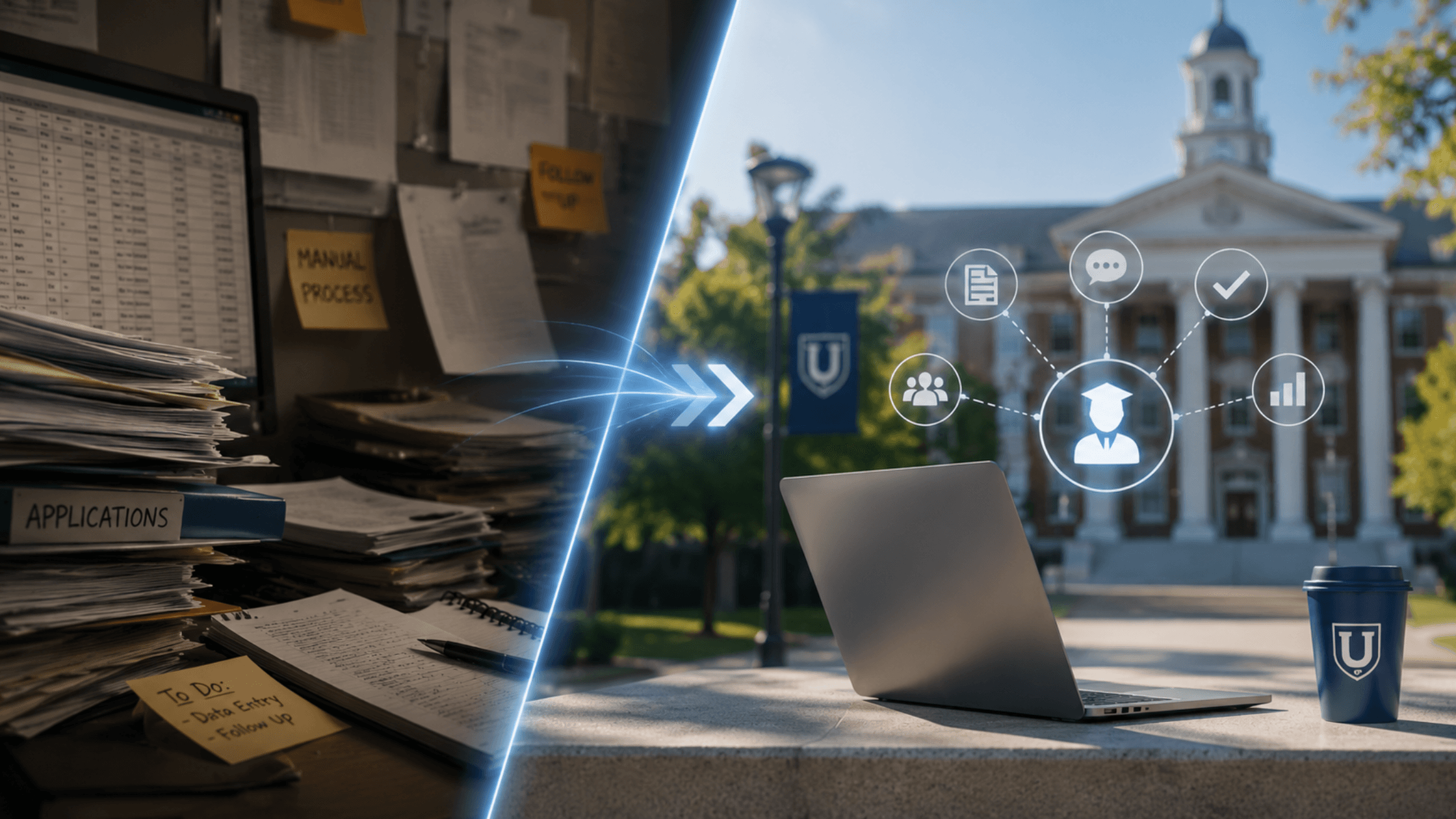
Higher education institutions are operating in an environment defined by increasing competition, evolving student expectations, and mounting operational pressure. Universities are expected to deliver seamless applicant experiences while simultaneously managing rising application volumes, maintaining data accuracy, and improving institutional efficiency.
Yet for many admissions teams, the underlying systems and processes supporting recruitment and enrollment have not evolved at the same pace.
Across the sector, admissions operations are still commonly hindered by disconnected technologies, manual workflows, fragmented applicant data, and inconsistent communication processes. These challenges create friction not only for administrative teams, but also for prospective students navigating increasingly complex application journeys.
During a recent webinar hosted by SnapOn Software and NimbusPoint Consulting, industry leaders explored how universities are modernizing admissions processes through integrated CRM strategies, workflow automation, and intelligent data management.
The discussion highlighted a broader transformation taking place across higher education: the move away from siloed administrative systems toward connected, student-centric admissions ecosystems.
The Legacy System Challenge in Higher Education
Many universities have accumulated layers of technology over time. Admissions teams often work across separate CRM platforms, student information systems, finance applications, communication tools, and reporting environments — many of which were never designed to operate cohesively together.
As a result, institutions frequently encounter:
- Duplicate data entry across systems
- Limited visibility into applicant interactions
- Disconnected reporting structures
- Delayed communication workflows
- Increased operational risk from manual processes
- Difficulty scaling admissions operations efficiently
These inefficiencies are more than administrative inconveniences. They directly impact institutional agility, applicant engagement, and overall enrollment outcomes.
One of the most significant operational consequences is the absence of a unified applicant record. When inquiry data, application documents, communications, interviews, payments, and enrollment information exist across multiple systems, admissions teams are forced into constant context switching simply to manage day-to-day operations.
This fragmented environment creates delays, increases the likelihood of human error, and limits an institution’s ability to provide a modern applicant experience.
Why the Applicant Experience Has Become a Competitive Differentiator
Today’s applicants expect the same level of digital responsiveness and transparency they experience in other industries. They want timely communication, self-service capabilities, real-time updates, and frictionless interactions throughout the admissions journey.
Universities that fail to meet those expectations risk losing engagement long before enrollment decisions are finalized.
One of the webinar’s key themes was the growing importance of visibility — both for institutions and applicants themselves.
Modern CRM platforms such as Salesforce Education Cloud are enabling institutions to centralize applicant information into a single ecosystem, creating a comprehensive view of each student journey from inquiry through enrollment.
This connected approach allows admissions teams to:
- Access complete applicant histories in real time
- Automate communication workflows
- Standardize admissions processes
- Improve collaboration across departments
- Generate more reliable reporting and forecasting
For applicants, it creates a significantly more transparent and engaging experience. Self-service portals allow prospective students to track application progress, submit documentation, access support resources, and remain informed throughout the process.
In an increasingly competitive enrollment landscape, these capabilities are no longer viewed as optional enhancements. They are becoming foundational expectations.
Moving Beyond Manual Admissions Processes
A recurring challenge discussed during the webinar was the operational burden created by manual administrative tasks.
Many institutions still rely heavily on staff-driven processes to:
- Re-enter applicant information between systems
- Trigger communications manually
- Validate documentation
- Track application statuses
- Coordinate approvals and decisions
- Reconcile reporting data
This model is difficult to sustain at scale.
Beyond the inefficiency itself, manual processes often consume valuable staff capacity that could otherwise be focused on higher-value engagement activities, student advising, and strategic enrollment initiatives.
Automation is increasingly emerging as a critical solution.
By leveraging workflow automation within platforms like Salesforce Education Cloud, universities can create standardized, rules-based admissions processes that reduce administrative overhead while improving consistency and accuracy.
Automated communications ensure applicants receive timely and relevant updates without requiring staff intervention at every stage. Decision workflows can be configured around predefined requirements and templates, reducing delays and ensuring process alignment across departments.
Importantly, automation also improves institutional resilience. As application volumes fluctuate or staffing resources shift, scalable workflows help institutions maintain service quality without proportionally increasing administrative complexity.
Integration as the Foundation for Scalable Admissions
The conversation also emphasized the growing importance of system integration within higher education technology strategies.
Modern admissions ecosystems cannot operate effectively in isolation. CRM platforms, student record systems, payment gateways, marketing automation tools, and applicant portals must increasingly function as interconnected components within a broader digital infrastructure.
Several real-world university examples shared during the session illustrated how institutions are addressing this challenge.
In cases involving fragmented legacy environments, organizations consolidated applicant and admissions data into centralized Salesforce-based platforms while integrating external finance systems, marketing tools, and UCAS workflows. These integrations enabled universities to eliminate duplicate processes while improving data continuity across departments.
The ability to maintain synchronized data between systems creates significant operational advantages:
- Reduced administrative duplication
- Improved reporting accuracy
- Faster application processing
- Enhanced applicant visibility
- Better cross-functional collaboration
- Stronger compliance and governance
As institutions continue investing in digital transformation initiatives, integration strategy is becoming increasingly central to long-term operational scalability.
Expanding Admissions Through Flexible Intake and Data Capture
While enterprise CRM platforms provide the foundation for admissions modernization, institutions also require flexible tools to support the many operational touchpoints that exist beyond core application workflows.
This is where solutions like SOS Intake are changing the game for data capture, playing an increasingly important role.
The webinar highlighted how modern intake platforms can support a wide range of university use cases, including:
- Open day registrations
- Event engagement
- Student program sign-ups
- Mobile field data collection
- Facilities requests
- Sponsorship and internship programs
- Campus feedback initiatives
These types of workflows often sit outside traditional admissions systems but remain critical to the overall student lifecycle.
Mobile-first data capture capabilities, QR-code-driven forms, conditional logic, file uploads, digital signatures, and direct CRM integrations allow institutions to simplify information collection while maintaining centralized data governance.
This flexibility enables universities to extend digital transformation efforts beyond admissions alone and into broader operational processes across the institution.
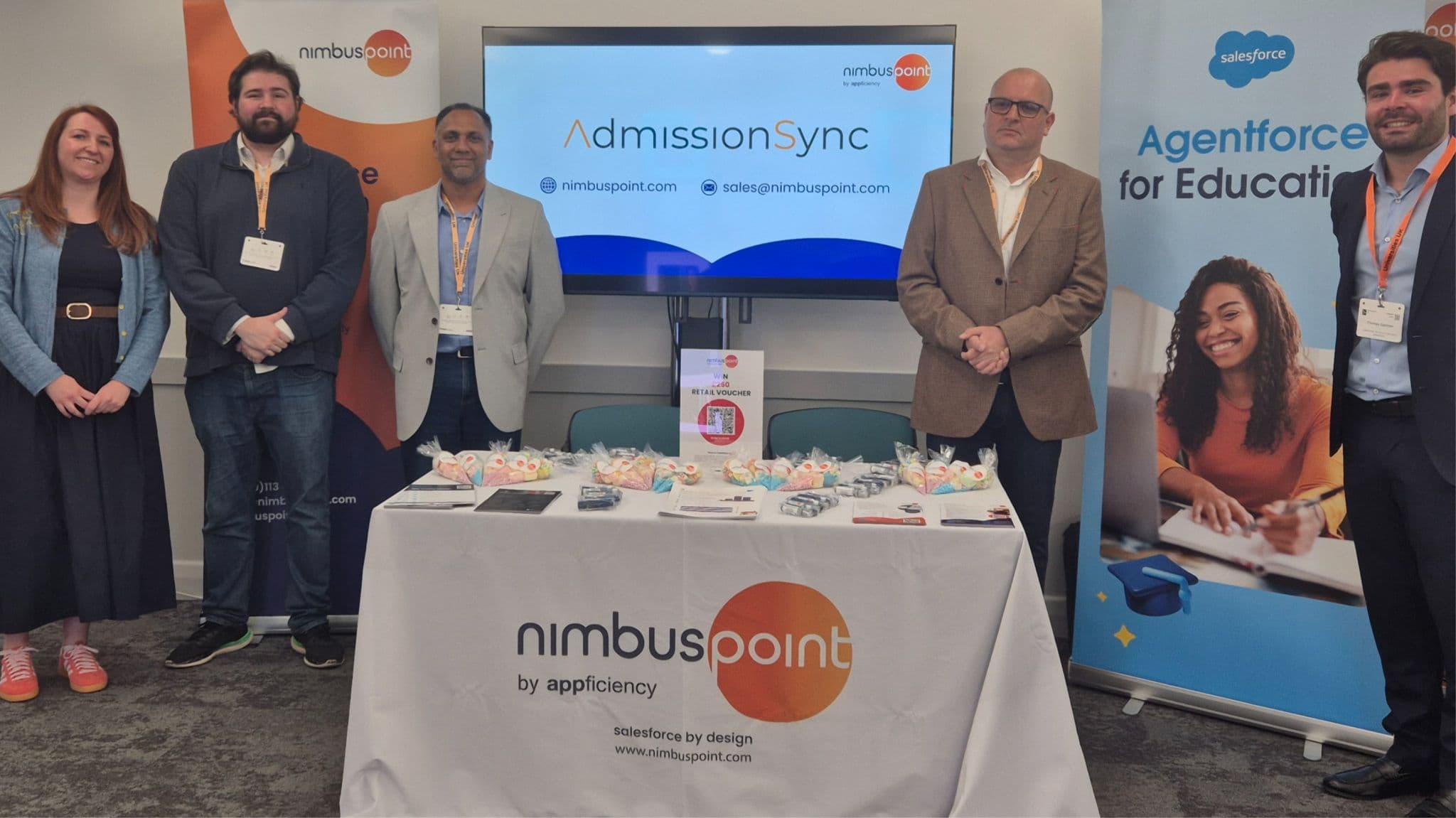
NimbusPoint at the Universities UK Transformation and Efficiency Summit using SOS Intake.
The Data Migration Reality
Despite the clear advantages of modern admissions ecosystems, implementation remains one of the most complex aspects of digital transformation in higher education.
One of the most important insights discussed during the webinar was the role of data readiness.
Legacy systems frequently contain inconsistent, duplicated, or incomplete records accumulated over many years. Successful modernization initiatives depend heavily on establishing clear data governance practices and identifying consistent applicant identifiers across systems.
Institutions must often address:
- Duplicate records
- Inconsistent formatting
- Legacy process dependencies
- Incomplete applicant histories
- Departmental ownership conflicts
Technology alone cannot resolve these challenges. Effective transformation requires operational alignment, stakeholder collaboration, and a phased implementation strategy that balances modernization goals with institutional realities.
Many institutions are therefore adopting MVP-based rollout approaches, beginning with foundational process mapping and requirements gathering before expanding into larger end-to-end implementations.
The Future of Admissions Is Connected
The higher education sector is entering a period where operational efficiency and applicant experience are increasingly intertwined.
Universities can no longer afford admissions processes built around disconnected systems and reactive manual workflows. Institutions that modernize successfully are those creating connected ecosystems capable of delivering visibility, automation, scalability, and engagement across the entire applicant journey.
What emerged clearly from the webinar discussion is that admissions modernization is no longer simply an IT initiative. It is becoming a strategic institutional priority tied directly to enrollment performance, operational resilience, and long-term competitiveness.
The institutions leading this transformation are not only reducing administrative friction — they are redefining how universities engage with students from the very first interaction.
As applicant expectations continue evolving, the ability to provide seamless, data-driven, and student-centered admissions experiences will increasingly separate institutions that adapt from those that struggle to keep pace.
If you’re looking for similar results, request a demo for SOS Intake here.
We ran a webinar with our partners at NimusPoint discussing how higher education institutions are modernizing and optimizing their admissions process. If outdated systems are holding your admissions back, here is the recording: Zero Re-Entry, Full Visibility: How Universities Are Transforming Their Admissions Process
About the Author
Alex Fajgenbaum
Head of Operations