Beyond Generic Forms: How Industry-Specific Templates Transform Business Data Collection: Market Research Forms CRM-Integrated Customer Insights
.png&w=3840&q=75)
Series Introduction (to use in each post): Business IT leaders face a common challenge: collecting structured data from employees, customers, and partners without building custom applications or relying on limited tools like Microsoft Forms. SOS Intake from SnapOn Software addresses this with purpose-built templates that connect directly to Microsoft 365 and Salesforce, offering capabilities that generic form builders simply cannot match. This series explores five industry-specific templates that demonstrate how ready-made solutions can accelerate deployment while maintaining enterprise-grade functionality.
Marketing teams spend thousands on survey tools that don't integrate with their CRM, forcing manual data compilation that delays insights. The Market Research Form Template writes directly to Salesforce or Microsoft 365
Marketing and product teams invest significant resources in understanding customers, yet the tools they use for market research often create more problems than they solve. Generic survey platforms like SurveyMonkey or Typeform collect responses but leave data isolated from CRM systems, requiring manual export, cleanup, and import processes that delay insights and introduce errors. Microsoft Forms offers basic survey capabilities but lacks the conditional logic needed for sophisticated market research and provides no native integration with Salesforce or meaningful integration with CRM data in Microsoft 365.
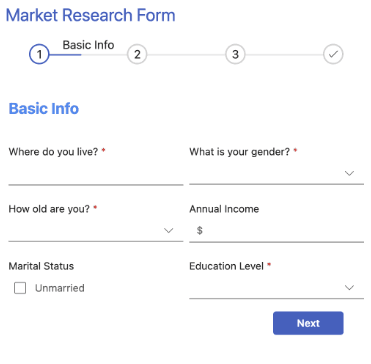
By using SOS Intake and the Market Research Form Template, organizations can collect data in three logical sections:
- The profile information section collects age range and generation cohort, income bracket, geographic location, industry and job role, and company size for B2B research.
- The product interests section captures current product usage and satisfaction levels, feature preferences and priorities, unmet needs and pain points, competitive product usage, and purchase intent with timeline.
- The current services section documents existing solutions and vendors, service satisfaction levels, budget allocation, decision-making processes, and switching barriers.
This structured approach ensures consistent data collection across research initiatives while making it easy for respondents to provide complete information.
SOS Intake's conditional logic transforms static surveys into dynamic research instruments that adapt based on responses. This intelligent branching increases completion rates by ensuring respondents only see questions relevant to their situation. The platform's multilingual support allows organizations to deploy research across global markets with forms automatically displaying in respondents' preferred languages, eliminating the need to create and manage separate forms for each language.
Direct CRM integration transforms market research from a disconnected activity into a strategic data asset. When connected to Salesforce, research responses create or update Lead records with demographic data, populate custom fields with product interests and preferences, trigger campaigns based on research responses, and enable audience segmentation for targeted follow-up. This integration means research data immediately becomes actionable, enabling marketing teams to launch targeted campaigns, product teams to prioritize features based on actual customer input, and sales teams to personalize outreach based on stated needs and preferences.

For IT leaders supporting marketing operations, SOS Intake eliminates the middleware and custom integration work that traditional survey tools require. The Market Research Form Template can be customized with industry-specific questions, branded to match corporate identity, deployed across multiple channels including website embeds, email campaigns, social media, and QR codes at events, and configured with consent mechanisms for privacy compliance. Most marketing teams deploy their first research form within an hour, compared to the days or weeks required to configure traditional survey tools and build CRM integrations.
About the Author
Peter Baddeley
Director, Sales and Client Solution