Solving the Auditing Challenges of Large Microsoft 365 Tenants
What constitutes a "large" Microsoft 365 tenant is not simply a function of user count. It is more accurately defined by the volume and complexity of the environment relative to the resources available to manage it. Organizations with tens of thousands of SharePoint sites and Teams workspaces, 100s of terrabytes of stored data, and extensive networks of guest and external users face governance challenges that are qualitatively different from those of smaller environments. The sheer volume of content, access relationships, and activity makes it practically impossible to maintain a clear picture of security posture, storage consumption, and compliance risk using manual methods or basic platform reporting.
Three challenges appear consistently across these large Microsoft 365 environments:
- Oversharing: Content shared externally through anonymous links or broad sharing permissions accumulates quietly over time. The resulting exposure is difficult to quantify without a consolidated tenant-wide view, and remediating it at scale without purpose-built tooling can consume weeks of IT resource.
- Orphaned workspaces: When employees leave an organization, the Teams and SharePoint sites they owned often persist without active ownership, retaining permissions that should have been reviewed and remediated long ago.
- Storage costs: Large files and unexpectedly high-consuming sites drive up Microsoft 365 costs in ways that are hard to manage without clear visibility at the tenant level.
Native admin reports, while useful as a starting point, are distributed across multiple admin centers, can take hours or days to generate at scale, and do not support the kind of delegated administration that allows content owners to manage their own workspaces independently.
Audit from SnapOn Software was designed to address these challenges directly. It is a native Microsoft Teams application that provides comprehensive visibility into guest access, sharing links, orphaned users, and storage consumption. Reports are generated on-demand using Microsoft Graph APIs, delivering current and actionable data in a familiar interface that requires no additional training.
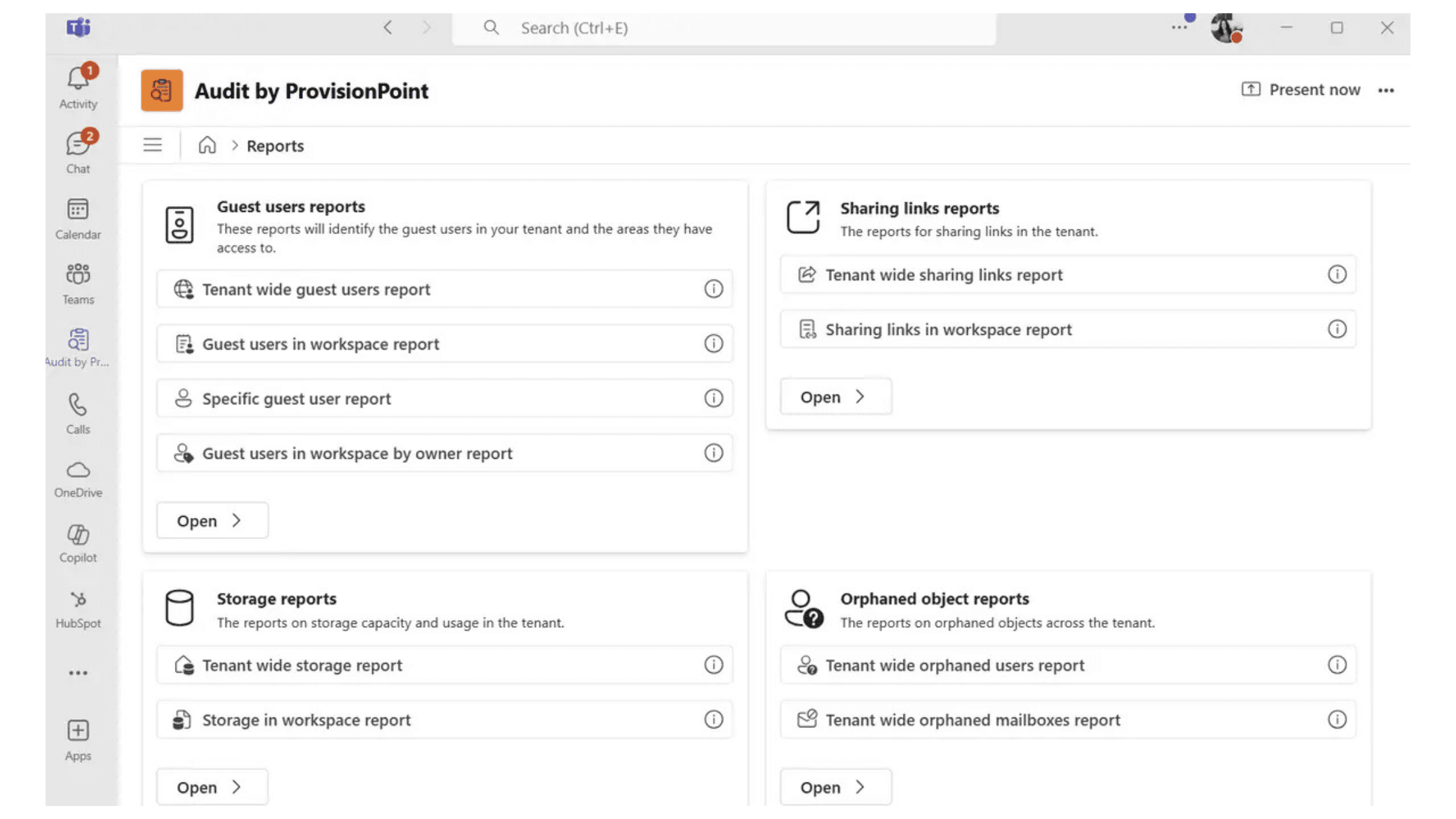
The delegated administration model, in Audit, is a particular advantage in large environments. Site and Team owners can view and act on governance information for their own workspaces, distributing the compliance workload across the organization rather than centralizing it entirely within an already stretched IT function.
For organizations managing large and complex Microsoft 365 environments, the ability to see clearly across the tenant is foundational to every other governance effort. Security remediation, compliance reporting, storage optimization, and departed user cleanup all depend on having accurate, timely, and actionable information.
About the Author
Peter Baddeley