Your Data Lifecycle Already Exists. Do you understand it?
Your Data Lifecycle Already Exists. Do you understand it?
Most leaders in regulated industries spend considerable time thinking about cybersecurity. Firewalls, endpoint protection, access controls. But there's a foundational risk that often goes unaddressed. It's your data lifecycle.
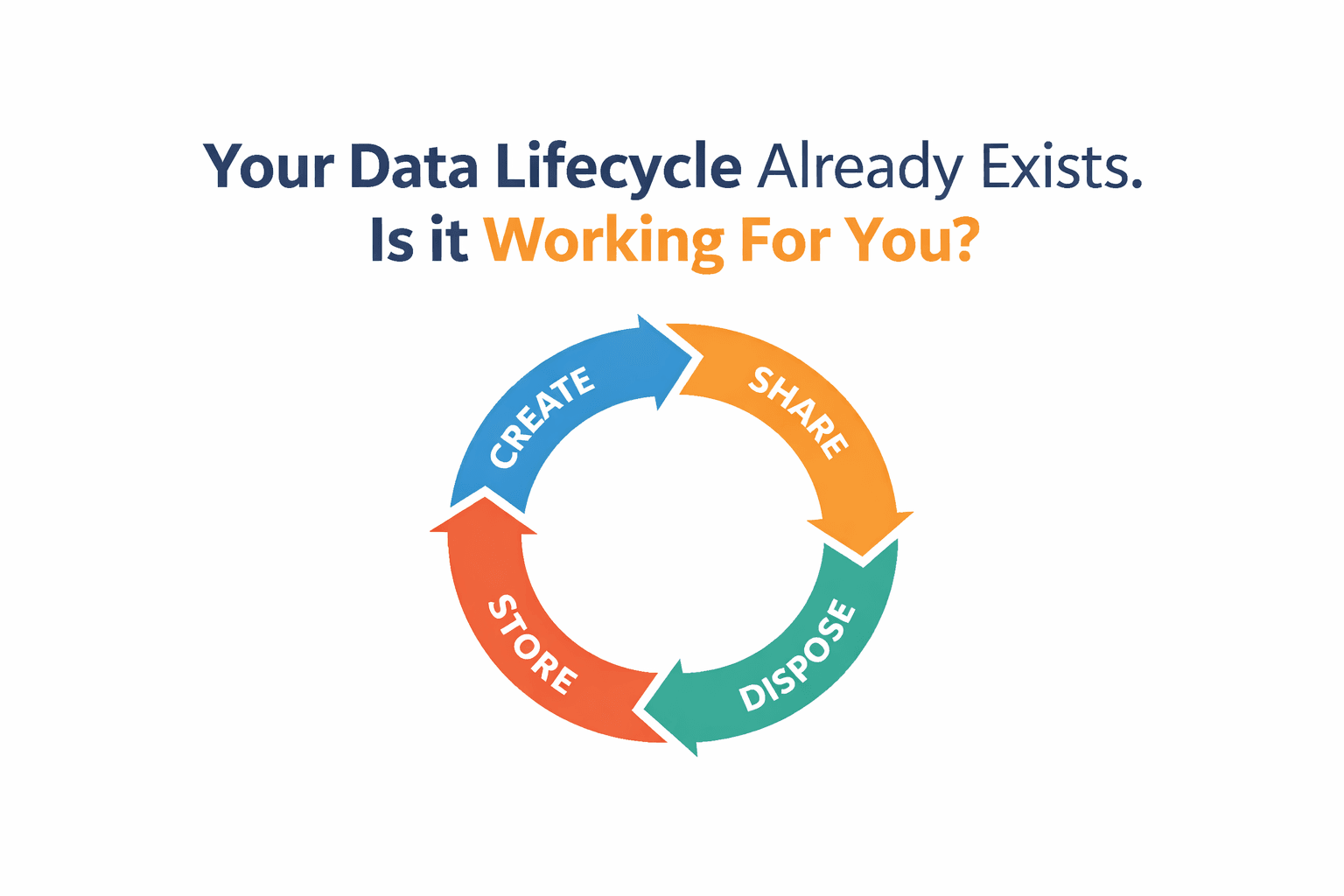
Every organization has a data lifecycle. They create, share, store, and disposes of data. That process is happening right now, across every team, every platform, and every device in your environment. The question isn't whether you have a data lifecycle. The question is whether it's working for you or against you.
Most Data Lifecycles Are Informal
In the organizations we work with, the data lifecycle rarely starts with a policy. It starts with a person creating a document, sending an email, or filling out a form. No label. No classification. No defined retention period.
When your lifecycle is informal, the consequences tend to compound quietly. Sensitive information accumulates in places it shouldn't be. Access permissions outlive the relationships they were built for. Data that should have been deleted years ago sits in a repositories like SharePoint and Teams, and no one has opened it in months.
What Is Actually at Stake
The reality of a data breach isn't always a dramatic external hack. More often, it looks like this:
- Personal data shared with the wrong recipient
- Confidential information forwarded to a competitor contact
- Sensitive records appearing in a search result they shouldn't be in
When that happens in a regulated industry, the consequences extend well beyond the immediate incident. These include:
- Regulatory penalties
- Operational disruption
- Reputational
- Loss of the public trust
What this tells us is that getting data governance wrong is expensive. The problem is that our risk exposure is increasing.
AI Changes Everything About Your Risk Exposure
Generative AI tools are being adopted rapidly across organizations of every size. Microsoft Copilot, embedded AI in your CRM, AI-powered search. These tools are powerful. They are also honest about your governance posture.
AI doesn't respect informal access boundaries. If a document exists and a user has access to it, AI can surface it. If data was never classified, AI can't protect it. If your environment is full of over-retained, unlabelled data, AI makes that data instantly discoverable in ways that weren't possible before.
AI amplifies what you've built. If your foundation has gaps, AI makes those gaps visible in the worst possible moments.
Where to Start
The first step is defining your data lifecycle. In the next post in this series, we'll walk through each of those four stages of data lifecycle and the specific risks that live inside each one.
About the Author
Peter Baddeley
Director, Sales and Client Solution