Your Next Employee May Be an AI Agent. Is Your Governance Ready?
AI agents are becoming digital workers—bringing new questions of ownership, access, accountability and control

For years, Microsoft 365 governance was largely an IT conversation.
- Who owns this SharePoint site?
- Who has access to that Team?
- Should this workspace still exist?
- How long should this information be retained?
Important questions—but rarely CEO questions.
AI agents are changing that.
We are moving toward organizations where digital workers will increasingly search information, analyze data, communicate, create content and eventually initiate business processes alongside human employees.
And that changes the governance equation.
- An employee can accidentally access information they should not see.
- An AI agent can potentially do it at machine speed.
- An employee can make a bad decision.
- An autonomous agent can potentially make hundreds before someone realizes there is a problem.
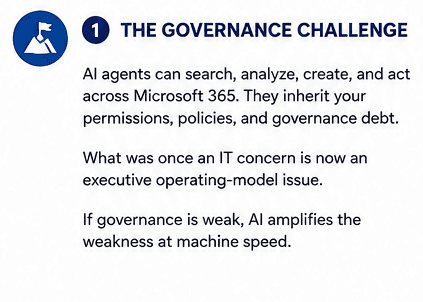
This is why I believe AI governance is rapidly becoming an operating-model issue, not simply an IT policy issue.
The Microsoft ecosystem itself illustrates how quickly this transition is occurring.
Organizations can already create SharePoint agents grounded in selected organizational content. Microsoft has introduced governed workflows for publishing internally created agents through its Agent Store, while Agent 365 increasingly provides inventory, observability and security capabilities around agents.
At the same time, Microsoft is telling organizations something very important:
Copilot and agents operate using the access already present in the environment.
That sounds reassuring.
But there is another way of reading it:
AI inherits your governance maturity—and your governance debt.
Microsoft's own current Copilot-readiness guidance recommends identifying potentially overshared content, inactive or ownerless sites, inappropriate sharing settings and sensitive information before expanding AI usage.
The community conversation reflects the same concern. Recent Microsoft 365 discussions continue to focus on years of permission creep becoming far more visible once Copilot can discover information that users technically had permission to access but may never have known existed.
AI does not necessarily create the governance problem.
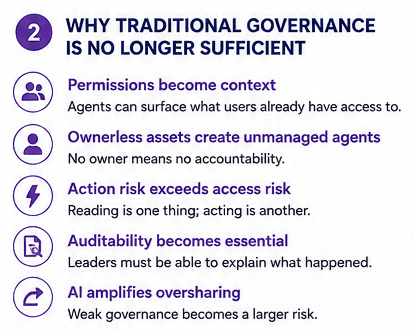
It exposes it. Then it amplifies it.
When someone joins your company, you don't normally give them unrestricted access to every system and tell them to figure out what they need.
- They receive an identity.
- They receive a role.
- That role determines access.
- Their activity can be audited.
- Their permissions change when their responsibilities change.
- And when they leave, their access disappears.
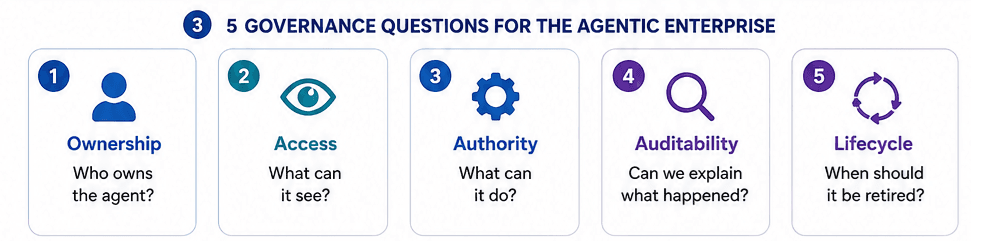
Why should an AI agent be fundamentally different? This leads to five questions I believe executive teams should start asking.
Every meaningful agent should have a clearly accountable business owner.
Not merely the developer who created it.
Someone should be responsible for why it exists, what business outcome it supports, what information it accesses and whether it should continue operating.
An agent without an owner is the AI equivalent of an ownerless workspace—except potentially far more powerful.
This may become one of the most important questions in enterprise AI.
An agent's intelligence is partially determined by the context available to it.
But more context isn't always better.
Organizations should deliberately determine what information an agent needs, rather than simply allowing it to consume everything technically available.
Microsoft is explicitly emphasizing controls around oversharing, permissions and sensitive content as organizations prepare SharePoint for Copilot and agents.
The principle should be familiar:
Least privilege must become least context.
Reading information and taking action are very different risk categories.
An agent summarizing project documents represents one level of risk.
An agent that can approve something, modify a record, communicate externally, trigger a workflow or initiate a financial transaction represents another.
Governance should therefore move beyond:
Who has access?
toward:
Who—or what—is authorized to act?
The distinction becomes increasingly important as agents gain autonomy.
Every organization eventually encounters the same executive question after an incident:
What happened?
With autonomous systems, answering that question becomes more complicated.
Organizations need visibility into agent identity, access, actions and lifecycle.
Microsoft's, EU's, UN's and other organizations direction reflects this emerging requirement: its agent registry and observability capabilities are intended to provide a consistent inventory and security posture for agents.
The future enterprise audit trail may therefore include not only:
User → Action → System
but:
User → Agent → Decision → Action → System.
That chain must remain visible.
We have spent years learning that collaboration environments accumulate digital debris.
- Unused Teams.
- Abandoned SharePoint sites.
- Expired projects.
- Ownerless workspaces.
AI agents could create the next generation of enterprise sprawl.
A temporary project agent should not automatically become a permanent digital employee.
Agents need lifecycle management:
Create → Approve → Operate → Review → Retire.
Governance must be designed into that lifecycle rather than added once hundreds of agents already exist.
It is tempting to measure AI progress by adoption.
- How many employees use Copilot?
- How many agents have we created?
- How many processes have we automated?
Those numbers matter. But they don't tell us whether the organization is becoming more intelligent. A better executive question might be:
How much autonomous capability can our organization safely absorb?
Because AI maturity is not simply the ability to deploy agents quickly. It is the ability to deploy them without losing visibility, accountability or control.
- That requires technology.
- But it also requires operating discipline.
- Identity.
- Ownership.
- Permissions.
- Information architecture.
- Lifecycle management.
- Auditability.
- Human accountability.
These may sound like governance concepts. Increasingly, they are becoming business architecture.
There is a tendency to think governance slows innovation. In the agentic era, I suspect the opposite will increasingly be true.
Organizations with clean information environments, mature identity controls, clear ownership and automated lifecycle governance will be able to give AI greater autonomy with confidence.
Organizations without those foundations may discover that every AI initiative creates another risk discussion.
This is where solutions like SnapOn Software's ProvisionPoint can help turn governance from a manual process into an automated foundation for AI readiness. Executives are using ProvisionPoint to automate Microsoft 365 governance, standardize how workspaces are created and managed, control permissions and access, and apply lifecycle policies consistently across their environments. As AI agents become more deeply embedded in everyday work, having these controls already in place can make it easier to scale adoption without scaling governance risk alongside it.
The winners may therefore not be the companies that deploy the most agents first. They may be the organizations that build the governance architecture that allows them to deploy thousands safely.
That is a very different definition of AI readiness—and one ProvisionPoint is designed to help organizations put into practice.
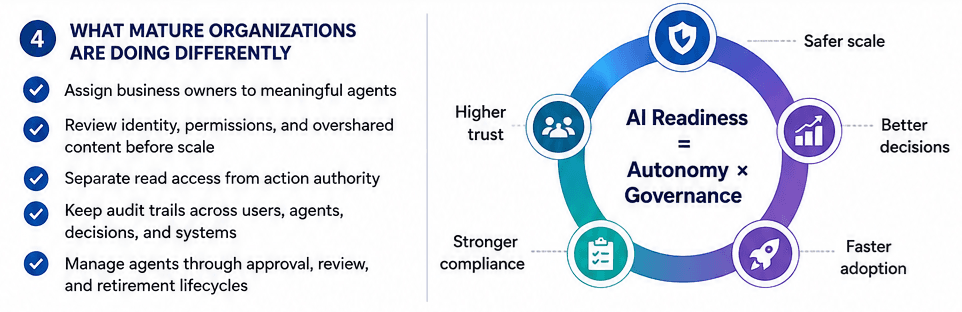
AI readiness should not be measured by how many agents an organization can deploy.
It should be measured by how much autonomy the organization can safely and responsibly give them.
That distinction matters. Creating agents is becoming easier. Governing them at scale—across identities, permissions, information access, actions, audit trails, and lifecycle—is the harder challenge.
The organizations that create the greatest value from AI will not necessarily be the ones that move fastest. They will be the ones that combine AI ambition with operational discipline.
That means establishing:
- Clear business ownership for every meaningful agent
- Visibility into what each agent can access and do
- Strong identity and permissions controls
- Separation between the ability to read information and the authority to take action
- Auditability across users, agents, decisions, and systems
- Lifecycle governance so agents are reviewed, renewed, restricted, or retired when appropriate
This is why governance should not be viewed as the mechanism that slows AI adoption.
Done properly, governance is what makes greater autonomy possible.
An organization with strong controls, trusted information, clear accountability, and visibility can safely allow AI to do more. An organization without those foundations will eventually be forced to choose between slowing down innovation or accepting risks it cannot fully understand.
The executive question therefore is not:
“How many AI agents have we deployed?”
It is:
“How confidently can we allow those agents to operate on behalf of our organization?”
And perhaps the most useful test is a simple one:
If every employee in your organization could create a digital worker tomorrow, would your governance model be ready?
That may be one of the clearest measures of whether an organization is truly prepared for the agentic enterprise.

If you’re an executive looking for governance solutions, check out ProvisionPoint by SnapOn Software.
Ready to get started?
Experience the benefits of our product today.